

Want to turn viewers into donors? The key is strategy. Nonprofit videos need to inspire trust, honor your mission, and lead to real support.
To do that, your videos should:
- Tell authentic, dignity-driven stories
- Align with your fundraising goals
- Include clear, measurable calls to action
- Be built to repurpose across campaigns
- Reflect your values, not exploit emotion
That’s where Jungle Films comes in.
As a strategy-first production partner, we help nonprofits like yours uncover powerful stories, craft impactful messaging, and produce campaigns that convert compassion into commitment.
Keep reading to learn how to plan, produce, and maximize nonprofit videos that get results.
What Kind of Nonprofit Video Should You Create?

Not all videos serve the same purpose, and that’s exactly the point. To drive results, you need the right kind of video for the right moment in your campaign. Different formats speak to different stages of the donor journey, so a one-size-fits-all approach won’t cut it.
Here’s a breakdown of high-performing nonprofit video types and when to use them:
- Explainer Videos – Great at the top of the funnel. These videos clarify your mission, programs, or a specific issue you’re tackling. Think of them as orientation pieces that build awareness and credibility.
- Testimonial Videos – Ideal for the decision stage. Real voices from donors, volunteers, or beneficiaries add authenticity. They show prospective supporters that others believe in your work, and they should too.
- Impact Stories – Your emotional engine. These narrative-driven videos center around a single transformation or outcome. When timed near year-end appeals or major campaigns, they help drive donations by showing real-world change.
- Data-Driven Videos – Best for simplifying complex work. Use these mid-funnel to clarify how your nonprofit makes a difference or to visualize outcomes in a way that’s digestible and memorable.
The best-performing fundraising videos are those built with clear intent: who it’s for, what it’s supposed to achieve, and where it fits in your larger communication plan. When you think in terms of campaigns, not just content, your video becomes a catalyst.
Case Study: Market Street Mission - Give Your Best Gift Today
In a campaign with Market Street Mission, we helped tell a powerful story: just $2.82 can help transform a homeless neighbor’s life. The video followed one man’s journey, from looking lost and unhoused to appearing confident, clean, and cared for, thanks to the support of donors.
How to Tell Authentic Stories Without Exploiting Anyone
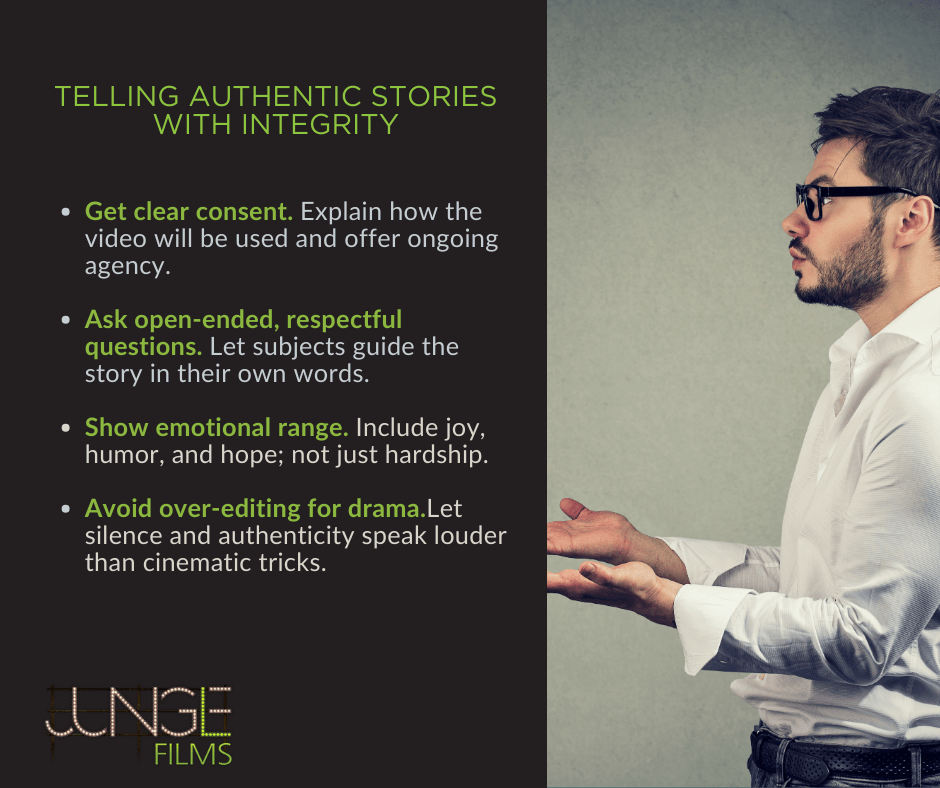
Emotional storytelling is the heartbeat of nonprofit video, but when done wrong, it can feel exploitative, performative, or even harmful. The goal isn’t to showcase suffering. It’s to show resilience, transformation, and impact through the lens of dignity.
The best nonprofit videos use strength-based storytelling, which focuses on the subject’s agency rather than their hardship. Instead of framing someone as a victim, it positions them as a change-maker, survivor, or advocate. This approach honors their humanity and avoids turning them into a fundraising tool.
To achieve that balance:
- Get consent early and clearly. Explain how the story will be used, and offer agency throughout the process.
- Ask open-ended, respectful questions. Let people guide the narrative in their own words.
- Include moments of joy, humor, and hope. Real people are multifaceted; showing emotional range deepens authenticity.
- Avoid over-editing for drama. Silence, pauses, and real moments often speak louder than swelling music or slow motion.
We’re often asked, “How do we tell emotional stories without feeling like we’re exploiting people?” The answer is simple: start with empathy, not agenda.
At Jungle Films, we spend time understanding the full context of a person’s experience before the camera ever rolls. We build trust, listen deeply, and co-create space where vulnerability isn’t extracted but offered.
When you create that kind of safe environment, the stories that emerge are not only powerful, they’re real. They connect without compromising. And they prove that integrity and impact are not mutually exclusive.
Budgeting, Timelines, and What to Expect

One of the biggest questions we hear is, “How much should a nonprofit video cost, and how long will it take?” The honest answer is: it depends. But with the right approach, you can plan smarter, avoid surprise costs, and get far more value out of your investment.
Budgeting for nonprofit video depends on a few key factors:
- Concept complexity – A single interview costs less than a multi-day shoot with multiple locations.
- Crew size and gear – A lean two-person team is different from a full-scale production with lighting, audio, and gimbal operators.
- Post-production needs – Editing, animation, color grading, captions, and revisions. All can affect the final price.
- Deliverables – One main video or a suite of assets (teasers, cutdowns, verticals)? That changes the scope and the cost.
A realistic budget for a strategic, professionally produced nonprofit video usually starts around $8,000–$15,000 and scales up depending on goals. But here’s where it gets powerful: when pre-production is handled strategically, one shoot day can produce 6+ months of content, from a flagship video to social reels, testimonial cutdowns, and campaign promos. Remember that it’s about the long game, not just a single video.
Timelines matter just as much as dollars. On average:
- Pre-production (planning, scripting, scouting): 2–4 weeks
- Production (filming): 1–3 days, depending on complexity
- Post-production (editing, feedback, revisions): 3–5 weeks
We’ve seen many nonprofits rush into production thinking it’s the fastest path to results, but cutting corners upfront often leads to costly revisions later. Rushed timelines, unclear objectives, and “let’s just get something” attitudes kill creative clarity. Strategy saves money every time.
So if you’re unclear on scope or costs, you’re not alone. Most clients come to us having underestimated what’s involved. Our job is to demystify the process and lead with transparency. When everyone is aligned early, the final video doesn’t just meet expectations; it surpasses them.
Maximizing the ROI of Nonprofit Video
Video is an investment, but when it’s built on strategy, it becomes one with compounding returns. The key to maximizing your ROI is tracking what matters and planning your content ecosystem from the start.
Start by defining the right metrics for your goals:
- Donor conversion rate – How many viewers take action (donate, sign up, share)?
- Engagement rate – Are people watching to the end? Commenting? Sharing?
- Retention impact – Does video increase repeat giving, event attendance, or newsletter opt-ins?
- Traffic and time-on-site – Videos on your landing pages often increase both.
But ROI isn’t just about immediate donations. Some of your best-performing content won’t go viral, it’ll show up at a board meeting, in a grant proposal, or as the closer to a donor appeal email. That’s impact that’s harder to quantify but critical to your mission.
To stretch your investment even further, build a repurposing strategy into your pre-production plan:
One flagship video can yield:
- Teaser trailers for social
- Testimonial snippets for email
- Vertical cutdowns for Instagram and TikTok
- Slides for donor decks
- Behind-the-scenes moments for stories
- Clips for event reels or future campaigns
We often plan shoots with content mapping in mind, so instead of chasing a dozen videos later, you get a whole quarter’s worth of material from one well-thought-out production.
If you’ve wondered, “How do I measure ROI?” or “Is this just a sunk cost?”, you’re asking the right questions. Video is only expensive when it’s underutilized. When it’s tied to your fundraising goals and repurposed strategically, it becomes your most efficient storytelling tool. Not just once, but over and over again.
What Sets a Great Video Partner Apart? (And Why It Matters)
Choosing the right video partner can make or break your campaign, not because of the camera they use, but because of how well they understand you. Most production companies focus on delivering a product. But nonprofits don’t need products. They need partners who can help them articulate their mission and emotionally connect with the people who matter most.
So why do many agencies fall short?
- They treat nonprofit work like corporate content: templated, fast, and surface-level.
- They prioritize visuals over values, delivering sleek edits that say nothing real.
- They wait for direction instead of offering strategic leadership.
- They don’t ask the right questions and miss the deeper story as a result.
You can spot red flags early: generic proposals, little curiosity about your audience, or a portfolio that feels like it could belong to any org, in any sector. If they talk about gear before goals, walk away.
At Jungle Films, we take a different path. We don’t start with a shot list; we start with listening. We embed ourselves into your mission, your voice, and your internal language. We ask the hard questions upfront to ensure the final product isn’t both beautiful and real. We work best with nonprofits that want more than a vendor. They want a creative ally who can translate purpose into story and then story into action.
If you’re wondering, “What actually makes a video company worth it?”, it’s this: a team that leads with empathy, not ego. One that gets nonprofit nuance and knows how to build something that not only looks great but also moves people to give, advocate, and believe.
Ready to Get Started? Here’s How Jungle Films Can Help
If you’re ready to move beyond generic videos and into powerful storytelling that actually drives action, you need more than a production crew; you need a creative partner who gets your mission at its core. At Jungle Films, we specialize in helping nonprofits like yours move people with purpose.
Here’s how we do it differently:
- We start with strategy, not gear. Every project begins by clarifying your goals, message, and audience before we touch a camera.
- We embed ourselves in your mission. We don’t just ask what you do; we ask why it matters and how we can help you show that.
- We build long-term value. One shoot becomes months of content. One story becomes many conversations. One campaign becomes a movement.
We’re not interested in one-off videos. We work best with organizations that are committed to authenticity, clarity, and storytelling that drives real outcomes, whether that’s more donations, deeper engagement, or long-term trust.
If that sounds like you, let’s talk. Book a discovery call to turn your story into action.
Because your mission deserves more than attention, it deserves belief.