

Most corporate videos should be 60 to 120 seconds long.
That’s the sweet spot for audience retention, message clarity, and platform performance. But the right length depends on your goals, audience, and how emotionally compelling your story is.
When clients ask, “How long should our corporate video be?” what they’re really asking is: How do we keep people watching? And how do we make it count?
In truth, there’s no one-size-fits-all number. A 30-second social ad and a 4-minute training film serve entirely different purposes. But whether you’re telling a donor’s story or announcing a new product, your video’s length only works if every second earns its place.
Jungle Films believes in leading with story, not stopwatch. In this guide, I’ll show you how to think about video duration the way we do: strategically, emotionally, and always with your audience in mind.
Want the breakdown? It’s all below. Let’s get into it.
How Long Should a Corporate Video Be?
You’re trying to figure out how long your corporate video should be, but the better question is: what kind of video are you making, and who’s it for?
Because length isn’t just about time on a stopwatch, it’s about audience attention, platform behavior, and the story you’re trying to tell.
Here’s a quick guide Jungle Films uses in our project to align duration with intent:
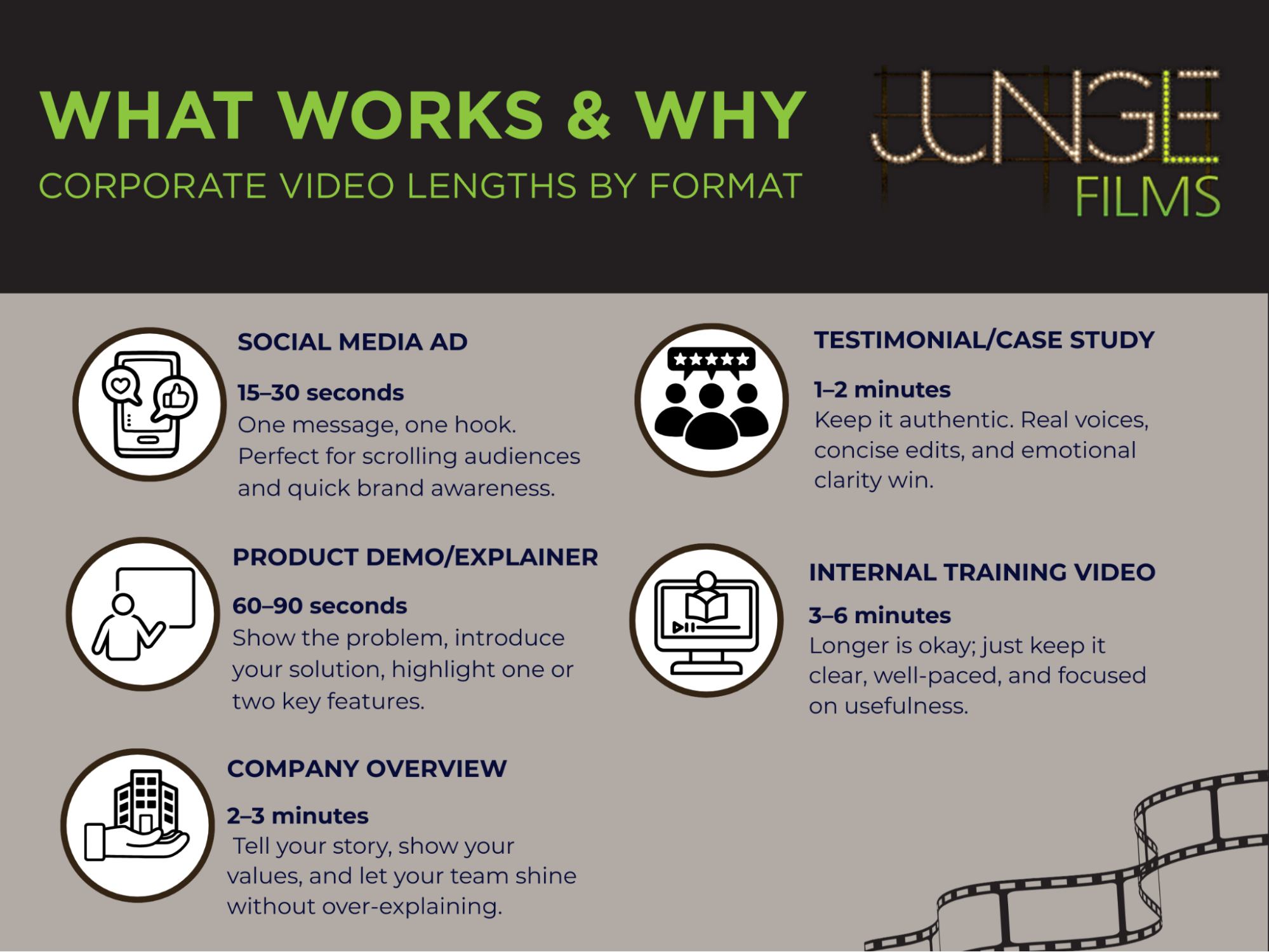
Quick Reference Guide by Use Case
- Social Media Ad: 15 to 30 seconds
Great for quick brand visibility. Viewers are scrolling, not settling in. You’ve got one hook and one message. Make it count. - Product Demo or Explainer: 60 to 90 seconds
Enough time to show the problem, introduce your solution, and hit a feature or two. Think punchy and benefit-first. - Company Overview: 2 to 3 minutes
This is where tone, values, and team come into play. It’s about telling your story, just without drifting into documentary territory. - Testimonial or Case Study: 1 to 2 minutes
Keep it human. Let real voices shine. Short testimonials tend to feel more authentic and avoid sounding rehearsed or forced. - Internal Training Video: 3 to 6 minutes
These can run longer if they’re informative, well-paced, and don’t try to pack in too much at once. Clarity over completeness.
What Should I Include in a Corporate Video Script?
Most teams we work with start with too much. Too many talking points. Too many voices. Too many slides. And the result? A video that says everything, except what actually matters.
The most effective corporate video scripts do a few things well. That’s it.
Here’s what to focus on:
- Start with the “why.” Don’t open with a feature list or stats dump. Begin with purpose. Why should the viewer care? What’s at stake?
- Skip the fluff. That includes long logo reveals, slow drone shots, or drawn-out intros. These moments feel good internally, but they’re the first thing viewers skip.
- Stick to one core message. If you try to say five things, the audience remembers none of them. A single focused takeaway is what sticks.
- End with a clear call to action. What’s the next step? Sign up, donate, schedule, share, be specific, and don’t assume they’ll figure it out.
Now, here’s the truth many creators wrestle with: “I feel like I’m trimming too much of our message.” We hear it often, especially when working with large teams or stakeholder-heavy clients.
But here’s what we always say, clarity isn’t about saying less; it’s about saying what matters. Jungle Films understood that it’s better to help you make one bold, clear point than three diluted ones.
So if something’s not pulling its weight in the script? Cut it. And watch your video get sharper, stronger, and more watchable.
Best Format for a Corporate Video Script
If you’re staring at a blank doc thinking, Should this look like a movie script or a PowerPoint outline?, this section is for you. Script formatting is one of the most misunderstood parts of corporate video, yet getting it right makes every stage smoother, from shoot to edit.
Jungle Films’ Pro Tip:
- Use a two-column AV script format.
- Left column: visuals, b-roll, interviews, motion graphics, location notes
- Right column: audio, voiceover, interview snippets, sound design cues
- Include rough time estimates. It helps you manage pacing and spot where the video might drag or rush.
- Write how people actually speak. Skip corporate jargon, long run-on sentences, and passive phrasing. This isn’t a brochure, it’s a conversation on screen.
- Add emotional cues. Not just logistics like “show office exterior.” Instead, go deeper: “Close-up of team lead smiling as they welcome new hire, warm, energetic.”
Now, should you separate visuals and voiceover? Yes. Always. Doing so gives your creative team, client, and editor clear direction, without confusion or guesswork.
When done right, a great AV script is the backbone of a smooth production. And it keeps everyone, from CEO to cinematographer, on the same page.
Corporate Video vs. Commercial: What’s the Difference?
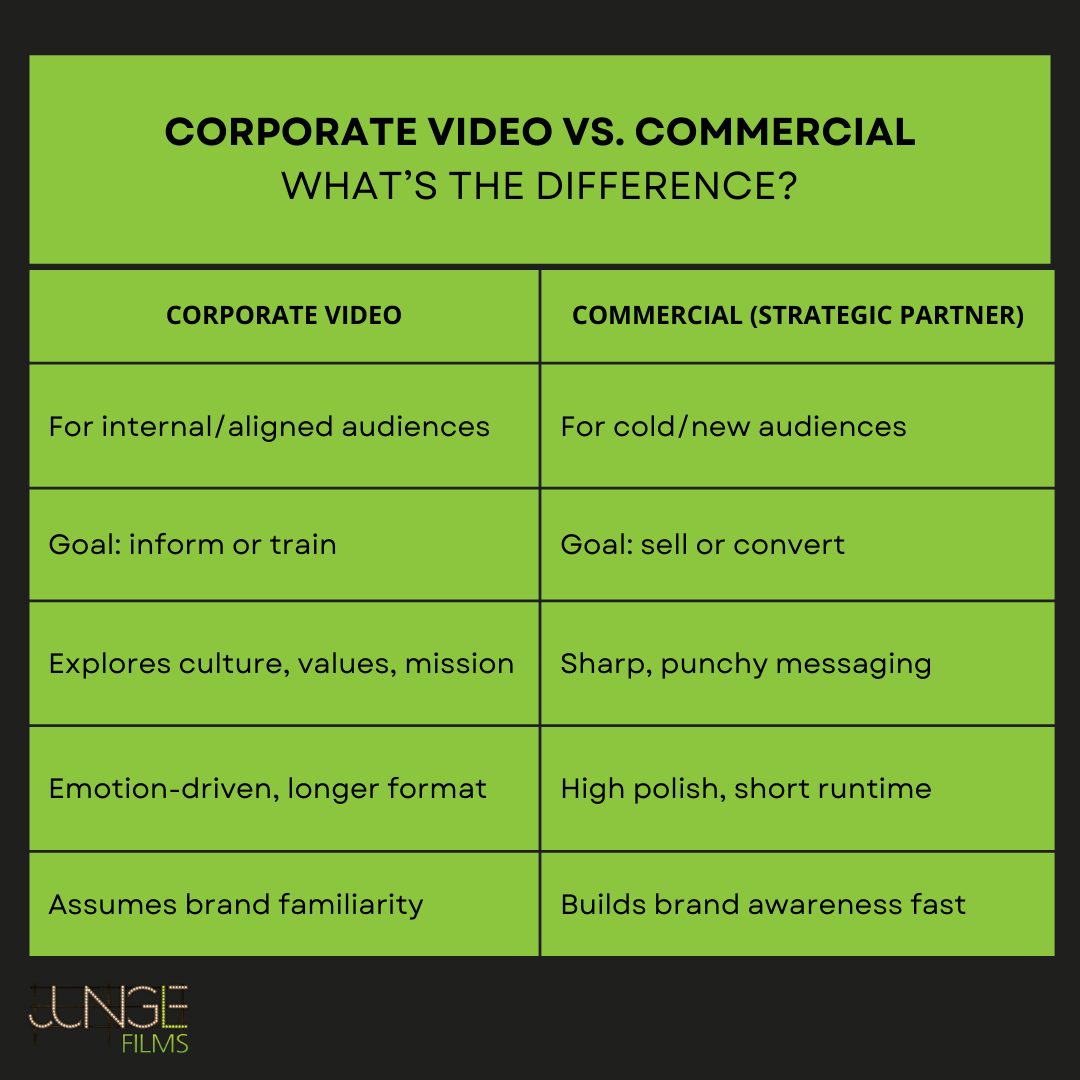
At first glance, a corporate video and a commercial might seem interchangeable. Both use video. Both involve storytelling. But they serve very different goals, and mixing them up leads to missed marks, confused messaging, and disappointed stakeholders.
So let’s clarify.
- Corporate videos are built for internal audiences or aligned with external ones. Think employees, partners, donors, or customers are already familiar with your brand. These videos inform, align, or train.
- Commercials, on the other hand, are built to sell. They’re made for cold audiences, people who don’t know you yet, and every second needs to earn attention fast.
Because of that:
- Corporate scripts can afford to go deeper. They can explore culture, values, and even emotions with a little more breathing room.
- Commercials need polish and punch. They rely on high production value, tight pacing, and clear calls to action.
So, what’s the difference between a corporate video script and a commercial script?
In short, one informs your team or your mission. The other persuades strangers. You’re either deepening trust or building it from scratch, so write for the right mindset.
We guide clients through that line all the time: tone and intention. A great commercial might inspire curiosity. A great corporate video builds connection. Both have power. But they aren’t the same tool.
Internal vs. External Videos: Script Differently
Tone is everything. And yet, many teams use the same voice whether they’re speaking to employees or total strangers. That’s where corporate videos fall flat; they forget who’s listening.
Here’s a simple rule: internal scripts should sound like a conversation. External scripts should sound like an invitation.
For internal videos:
- You’ve got more time. 3–6 minutes is often fine if the content is useful.
- You can use familiar language, inside references, and direct instructions.
- Specificity works. “Here’s how this affects you” lands better than general updates.
For external videos:
- You need to earn attention quickly. That means clarity, not cleverness.
- Keep it tight, 90 seconds is generous if they’ve never heard of you.
- Assume nothing. Spell out the value, the problem, and the solution fast.
“How do I tailor a video script for internal vs. external audiences?”
Ask yourself: Does this viewer already care? If yes, you can go deeper. If not, you need to hook them, and fast.
In Jungle Films’ scripts, this is one of the first filters we use. Because even the most beautifully shot video will fall flat if it speaks in the wrong voice. Matching tone to the audience is what transforms a script into a connection.
Case Study: Buttafuoco & Associates
Keep it human. Let real voices shine. Short testimonials tend to feel more authentic and avoid sounding rehearsed or forced.
One example is the testimonial we produced for Buttafuoco & Associates. In it, Francesca recounts a traumatic dog attack from her childhood. The video features both her and her parents reflecting on the fear, uncertainty, and emotional toll of the incident. But it also highlights the care and advocacy they received from Buttafuoco & Associates.
In one minute, the video delivers a moving narrative arc: from trauma, to trust, to justice.
Who Can Help You Do This Right?
At some point, most teams hit a wall. The script stalls. The message gets cloudy. And someone says, “Maybe we just need to hire a videographer.” But here’s the thing: a videographer isn’t a strategist. And a vendor who “just shoots what you give them” won’t help you build a story that moves people.
Not all agencies get this.
Some are excellent at technical execution. Others know how to make things look beautiful. But few know how to guide a brand through the messy, nuanced, emotional work of crafting a message that sticks, especially when it’s meant to resonate across departments, audiences, or missions.
Jungle Films doesn’t believe in just filming what’s on paper. We help shape the paper. That means:
- Asking the right questions before the cameras ever roll
- Helping you distill your message to its emotional core
- Scripting with voice, clarity, and pacing in mind
- And ensuring that every second of your video earns its spot
If you’ve been tasked with writing a script or wrangling feedback from stakeholders, you don’t have to go it alone. The right partner helps you get it right from the start. Because the best videos shouldn’t only look good, but also feel right. And that always starts with the story.
Ready to Make Every Second Count?
If you’re sitting on a rough outline, a half-finished script, or just a vague sense of what your video should be, let’s talk. Jungle Films helps mission-driven brands and organizations turn cluttered messages into clear, emotional, high-performing video stories.
From strategy to scripting to final cut, we’ve got your back.
Let’s build something that actually gets watched.
FAQ
What is the best format for a corporate video script?
Use a two-column AV (Audio/Visual) script. One side outlines the visuals (b-roll, interviews, motion), the other the audio (voiceover, interview beats). This keeps everyone, from director to editor, aligned.
How long should a corporate video script be?
It depends on the goal, but most fall between 60 to 120 seconds. Social videos are shorter; internal or explainer videos can stretch longer if they stay focused.
How do I start writing a video script from scratch?
Start with your objective, then identify one clear message. Outline the visual flow and voiceover or talking points. Keep the structure tight: hook, value, CTA.
What should I include in a corporate video script?
A clear opening hook, one focused message, concise voiceover, visual cues, and a strong call to action. Skip long intros and dense mission statements.
How do I make a corporate video script sound natural and not boring?
Write how your audience talks. Cut jargon. Use active voice. And build emotional momentum, even in a training video. Energy translates.
Should I write out the visuals and voiceover separately?
Yes. It improves clarity for production and helps align storytelling across teams. This is where the two-column format really shines.
How do I structure a testimonial-based corporate video?
Use a story arc: intro the person, show the challenge, reveal the transformation, and end with a strong emotional close or mission tie-in.
What’s the difference between a corporate video script and a commercial script?
Corporate scripts inform or align existing audiences. Commercials persuade strangers. One builds trust, the other earns attention, write accordingly.
Are there templates for writing professional video scripts?
Yes, but the best templates follow an AV format and are flexible enough to suit your voice, tone, and industry. Avoid cookie-cutter scripts.
How do I tailor a video script for internal vs. external audiences?
Internal videos can be longer and more casual. External scripts need to grab attention fast and speak to what matters most to new viewers.